
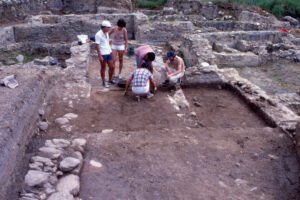
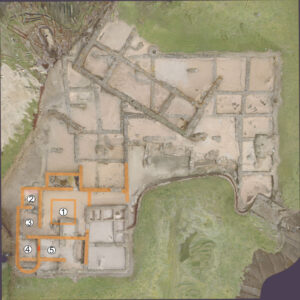
Archaeological excavations have brought to light a building related to the port activity of Roses in the Roman era. It is a large U-shaped building, with two clearly differentiated zones.
One entire wing was probably dedicated to storing products and merchandise, while in the other, a thermal building was constructed.
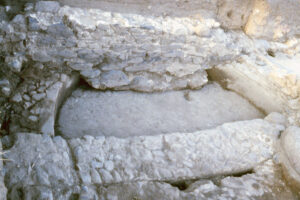
Bath buildings or thermae, balnea in Latin , were an essential element in Roman culture. The thermae were not only a hygienic space but also a meeting place. The port building (2nd century) was accessed through a door located to the east. In the centre, there was a small courtyard (palestra) for gymnastic exercises prior to bathing. From here, one could access a dressing room (apodyterium), a cold bath room (frigidarium), and a hot bath room (caldarium), with asemicircular pool heated by a furnace (praefurnium). The water was captured through wells that extracted it from the underground water courses that pass beneath the building.
This is a model that is repeated in many sites throughout the Girona province, as well as the Roman Empire. Furthermore, it should be noted that the thermae are a building often documented near ports, allowing sailors and travellers to relax after a few days at sea.
Source: J. M. Nolla.
Source: CRAPA.
Source: J. M. Nolla.